Showing posts with label 9mm. Show all posts

Tuesday, September 20, 2011

Quest for the Holy Handgun: Taurus pt917c

I love it when people comment on my blog.  Especially when a person leaves anonymous fishing/deer hunting tips for my area, and then comes back a few days later to leave me a comment that says "Sunday's Journal Star newspaper,Bass Pro ad.. Taurus 917,9mm-19rd= 349.00"  (Thanks again Anonymous, I appreciate the heads up and tips.)

So, I checked out the flier online.  Indeed, Bass Pro is selling Taurus pt917s at a $130 discount as part of their grand opening sale.  The only problem was I'd never heard of a Taurus 917.  Thus began a flurry of Googling, learning, and decision making.  To have all this new Taurus knowledge in my head and not compile it into a QHH post would be a crime.  So let's learn a bit about the Taurus pt917c.

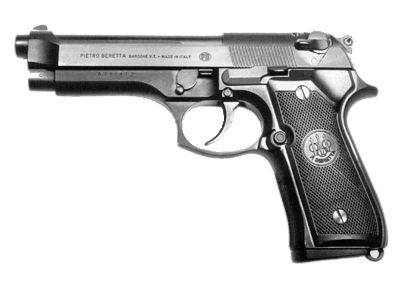
Beretta manufactures a gun the military has named the m92.  It has been the standard sidearm of our armed forces for 25 odd years.  If the name doesn't ring a bell, a picture will, I guarantee you've seen it.

"Ohhhhh, that one."


Anyway, back in the late 70's/early 80's, Beretta won a contract to sell a buttload of m92s to Brazil.  However, Brazil had a law that said guns had to be manufactured in Brazil to be sold in Brazil. (Kind of like how guns sold in the US have to have a certain amount of parts manufactured here in the States.)  So, Beretta builds this massive factory with the sole intent of mass producing m92s.  They make a bunch of them, sell them, and make a bunch of cash.  Then the contract is over.  They decide to sell the factory (along with all of the specialized m92 equipment) to Taurus.

Taurus of course starts pumping out m92 clones.  At first exact copies, then eventually making modifications such as moving the safety from the slide to the frame, adding an accessory rail, and increasing the magazine capacity from 15 to 17 to stay competitive with Glock. 

Minute differences


Eventually, they decided that the front of the gun could stand to lose about an inch from the barrel and slide. (The way the barrel stuck out of the front of the slide was goofy anyway IMO.)  The result of this cutdown was the pt917c:

See the difference?  This one has the 19 round mag in it and an aftermarket fiber optic front sight.


Let's take a look at some of my criteria and see how it matches up.  I'm going to leave out caliber since it's a 9mm and I think we've rehashed that I think that's a satisfactory caliber.

Reliability:  Being an almost exact copy of the sidearm our military uses should mean ultimate reliability, right?  You'd think so.  And in fact, Beretta is lauded for making a very quality product.  Search the internet for Taurus quality control and you'll get a mixed bag.  However, some of it seems to be guys that are upset they spent a couple hundred dollars more for a Beretta.  It's hard to find actual documented evidence of serious reliability issues.  The pt917 has a open top to the slide, which avoids alot of failure to eject malfunctions you can get in alot of other firearms.  Add to that the fact that Taurus has an unconditional lifetime warranty that follows the gun, not the owner (as in, I could buy used and still be completely covered under warranty) and Reliability comes out to be a PRO.

Capacity:  The pt917 ships with one 17 round and one 19 round magazine.  Whoa.  Highest factory capacity yet.  The 19 round magazine looks a little goofy, sticking out a bit, but no worse than a Glock magazine with a +2 extension.  (And they come standard at 19 rounds, so that means you don't have to tinker around, taking off the baseplate from your magazine and installing the extension yourself.)  When it comes to Capacity, the pt917 has to be a huge PRO.

Carryability: Believe it or not, the "c" in pt917c stands for compact.  Maybe it should be for "compact-er", because cutting that inch off the end of the gun doesn't make it compact by any means, only brings it down to the size of other full size pistols.  Combine that with a heavy weight (over 30oz.) and Carryability has to be a CON.

Misc.:
  • Looks:  I said above, I think cutting off the extra inch from the front of the gun was an improvement.  I think the original Beretta was designed that way so military operators could use a threaded barrel and use a silencer.  It looks like something the military would use in this chopped down configuration.  I like the safety switches and hammer.  The only downside is the 19 round mag looks crazy. (Which is remedied easily enough, just use the 17 rounder.
  • Customizability:  Meh.  The usual accessory rail allows lasers/lights/etc., and you get can get custom grips.  Other than that there's not alot of options.
  • History/Track Record:  The 617 has none.  However, the m92 (the gun that the gun that this gun is based upon is based upon, remember?) has been serving our military for over 25 years.  Does that translate to having any effect on the 617?  For me it does, but it's not that much.
  • Safety: Take the safety features of the 1911 and the SIG 2022 and put them together and there you go.  It has a safety lever AND decocker.  So you can walk around with one in the pipe and feel very secure in your guns ability to not go off.
  • Ambidextriociousness:  
The only real con detracting from the 917 in my eyes is its carryability.  Since I'm a big dude and it probably wouldn't be a hindrance for me, it's not a big deal to me.  Honestly, if I had the $350 I'd be buying this gun tomorrow night.  I have some spare cash but not enough and the sale is only lasting till the 9th.  After the price goes back up though, it's right on par with a Glock.  If I had to choose between the two at their standard rates, I'd probably go with a Glock just because of superior reliability and huge aftermarket... um... market.  

What do you think?  Would you pick up the 917 over something else?  Ever shot one before?

Coming soon on QHH: PPK, a Ruger handgun, and some kind of revolver.

Friday, September 16, 2011

Quest for the Holy Handgun: Sig Pro 2022

The history of SIG Sauer as a firearms company can be traced back to the 18th century.  It's a history that involves several different iterations of companies, all different kinds of firearms, and a good bit of Nazism thrown in for good measure.

Most of that doesn't really pertain to what we're going to talk about today so we'll skip over it.  The important part is that SIG Sauer has been making fine handguns for 25 years.  Guns such as the P226 have found a home in many militaries over the  years, and (according to SIG) one third of the United Stated police force uses SIG firearms.

With such a quality product comes the cost of producing such a quality product (MSRP of $993.00 for their popular P226) .  Around the turn of the century, competition from relatively inexpensive firearms such as Glock (MSRP $599.00 for the G17) lead to the development of the SIG Pro line of firearms, and eventually, the SIG Pro 2022.

SIG on the cheap!
While the slide and rails are very similar to a regular SIG firearm and metal, the frame of the gun is made of polymer like a Glock.  This helps keep costs down and puts a SIG firearm within the reach of budget-cut law enforcement agencies and prospective buyers like myself who just can't bring themselves to buy a $1000 pistol.

Let's take a look at some criteria and see how it measures up.

Reliability:  SIG Sauer has a very good track record when it comes to reliability.  There are some out there who hate on the SP 2022 because it is a polymer pistol and therefore not a "real" SIG.  That seems ridiculous to me as the benchmark for reliability is the Glock, THE polymer pistol.  The 2022 was reported to have 460,000 rounds put through it during development and testing by users who eventually adopted the pistol for service.  With all that in mind, for me, reliability is a PRO.


Price:  As I mentioned above, part of the reason for developing the 2022 is to lower cost.  The 2022 can be had for roughly $400 new in box.  This includes the gun, a separate backstrap to fit different sized hands, and a magazine.  This puts it a bit below the Glock but any buyer should know that some of SIG's accessories are pretty pricey ($46 for a spare magazine, yikes) so it evens the price out a bit.  Still, in comparison to the other SIG pistols and some other pricier options, price works out to a PRO.

Capacity:  I get a little confused here.  When I read that the 2022 in 9mm had a magazine capacity of 15 rounds, I assumed it was because it was smaller and more concealable than the Glock 17 (17 rounds).  However, when you check out the stats (7.4in x 1.4in x 5.7in for SIG vs. 7.3in x 1.2in x 5.4in for Glock) the SIG is bigger in every way.  What the hell?  What's the point?  If Glock could do it with a smaller pistol, why doesn't SIG have a capacity of 17 as well?  Doesn't seem like a good business decision.  If anyone knows why they did this, please let me know.  Theoretically, 15 should be more than enough to get the job done but 15 loses to 17.  Capacity in terms of a full size 9mm pistol is a CON.

Caliber:  We've gone over the caliber debate regarding 9mm in previous QHH entries.  It's a proven self-defense round, leaves the most room for extra rounds in a magazine, and is the lowest caliber accepted for USPSA competitions.  The 9mm is a PRO.


Carryability:  As mentioned in the capacity section, the 2022 is one of the biggest guns we've looked at so far.  It's also pretty heavy at 29oz.  Compared to the other options out there, Carryability is a CON.


Misc.:

  • Looks:  The 2022 falls somewhere between the Glock and the 1911 in looks for me personally.  It's got that bulky blocky look reminiscent of a Glock but the controls and hammer (absent on a Glock) give it that classic look. 
I personally like it.  There's something about a hammer on a pistol that speaks to me and screams out "PISTOL!".  Also, the accessory rail under the front of the gun adds a bit of a tacti-cool feel to the gun.
  • Customizability:  Speaking of tacti-coolness.  That accessory rail allows for any flashlight/laser that attaches to a picatinny rail to be tacked on to the bottom of the 2022.  The gun ships with an alternate backstrap to fit different hands and you have the option to add on night sights for a little bit more.  Beyond that, SIG doesn't have nearly the aftermarket support that Glock or the 1911 platform has.
  •  History/Track Record:  The law enforcement agencies of France ordered over a quarter of a million (the largest order of service firearms since WWII) 2022s in 2003.  Rock Island Armory put in an order for several thousand 2022s and picked up for use by the DEA.  Not as widely used as a Glock but it seems many thousand professionals trust their lives to the 2022 every day.
  • Safety/Simplicity:  Like the Glock, there is no safety lever or button to keep the trigger from being pulled.  Instead, when the hammer is lowered, the weight of the trigger pull more than doubles from 4.4lbs to 10lbs of pressure.  There is a decocker button that safely lowers the hammer without striking the pin and setting off a round in the chamber.  This allows the user to carry the gun around in a more-safe fashion.  If a gun is carried, it should be carried in a holster that completely covers the trigger guard.  If this is done and you're using your brain and keeping your finger off the trigger, all other safeties are redundant.  At least this is the sentiment prevalent in the firearms community.  I personally think I'd have to carry without a round in the chamber for awhile while I built confidence in my ability to not shoot my ass off.  There's also something to be said about having a safety if there is any chance a kid could get their hands on the gun, however remote and unlikely the chances are.
See that button below the slide release lever just above the grip?  That's the decocker.  
I actually had the guy at Gander Mountain pull this gun out of the showcase and let me handle it.  When I asked about the safety, he reached over and hit the decocker button and the hammer flew down.  I flinched like a little girl, expecting some non-existant round to go off.  It would take some getting used to.

So there we have it: 3 PROs and 2 CONs.  The pros and cons don't really tell the story of my opinion in this case though.   

I have a confession to make.  I came into this series with a clear ranking of pistols in my mind.  It played out like this:
  1. 1911
  2. SIG 2022
  3. Glock
My main reason for starting out this hole series of posts was to justify my purchase of a 1911.  After comparing just the four pistols I've done so far, my bias for both the 1911 and .45ACP cartridge has completely dissolved and if I were to make my decision today, my ranking would work out like this:
  1. Glock - Even if I still thought .45ACP was the be all end all, why get a pistol with an 8 round capacity instead of one with a 13 round capacity.  Even better since 9mm is enough IMO and gives you 17 rounds.  Add to that the reliability of a Glock and it has definitely taken the lead.
  2. CZ-82  - Cost alone keeps this above the other two.  Getting a gun and practicing with it by shooting 1500 rounds for the same price as just buying another gun makes you a better shot and better prepared.  
  3. 1911 - I had an infatuation with the 1911.  I still kind of have a gun-crush on it.  It is the gun that helped win both World Wars and served our military for 100 years.  It's a classic design.  That's the issue, its too classic in my eyes.  I still want one someday but I don't think it's the right first gun for me.
  4. SIG 2022 - Like a Glock but... not better.  Bigger, heavier, lower capacity, less customization options, more expensive accessories, and doesn't have the legendary ruggedness that the Glock does.  There isn't much in my mind to recommend it that isn't available elsewhere for the same price.  I think alot of SIG's reputation is made on their pistols that cost twice as much.
I think the more we go along, the more I drink the Glock kool-aid. (As I'm sure you can tell since I'm comparing everything to it as we go along.)  Honestly never thought I'd say that but it's won me over more and more as we check out more and more guns.  I'm still not done though.  We'll look at a few more and see if anything can knock Glock from the top of the mountain.  A Ruger pistol was suggested awhile back so I'll pick out one of those next and we'll see how it matches up.  After that, I might do a revolver, just for poops and giggles...  

Any other guns you would suggest or would want to learn more about?  Also, any thoughts on the SIG?  Is there something I'm missing that catapults it above the rest?  Let me know!

Friday, September 2, 2011

Quest for the Holy Handgun: Glock 17

Continuing my search for the ideal first handgun, we'll be moving on to one of the most popular guns in the world: the Glock 17.

Perfection?  I guess we'll see.
If you have no idea what I'm talking about with this whole Quest dealio, you should go read this post to check out the details and what criteria I'll be focusing on.  Then, go check out the first entry into the series on the m1911 platform, found here.  Go on, I'll wait...  All caught up?  Ok, let's learn a bit about the Glock.

In 1980, the Austrian military decided to hold a competition to find a new service pistol. (They had been using Walther p38s since the end of WWII.)  Up to that point, Glock was a company that produced quality  military knives, entrenching tools, etc.; but had never produced a firearm.  Gaston Glock put together a team of legit gunmakers to hopefully bring home the lucrative contract.  

The military had 17 criteria that the prospective pistols would be judged upon.  They ranged from pretty standard (must be able to be broken down without tools in the field, must be secure from accidental discharge from 6 feet, blah blah blah) to pretty hardcore (Must not have more than 20 malfunctions within the first 10,000 rounds; must shoot 15,000 rounds, fire a special over-loaded cartridge that would produce twice the pressure of a standard round and continue to function).  

Glock made a pistol to meet all of the criteria and named it the Model 17 as it was the company's 17th patent.  The Glock 17 proceeded to whip some established-gun-maker ass in the military trials, beating out such established names as H&K, Sig Sauer (also coming soon on QHH), and Beretta among others.  

The Glock 17 was truly revolutionary in that the lower half of the pistol is plastic.  A very strong plastic polymer.  This brought all kinds of jests from those who had carried metal 1911s and revolvers all their lives, earning the names Tactical Tupperware and Plastic Fantastic.  Despite the world's skepticism, the Glock's polymer has proven itself over the past 30 years and become an oft-copied design.

The Glock was shortly adopted by the Swedish and Norwegian militaries and was invited to the trials to replace the 1911 as the American service pistol.  However, the Department of Defense demanded a change in how the gun was manufactured in an unrealistic amount of time.  If given the correct amount of time to make the changes, there is a good chance Glock would have beaten out Beretta again and our soldiers would have been carrying Glock 17s for the past 25 years. (Tangent: There've been rumblings that the DoD is looking to replace that same Beretta and Glock could have a good shot at it if they actually hold a new set of trials)

Since then Glock has produced 22 different models of pistol in all different sizes and calibers.  They've gone through four generations (1: OG Glock 2: Changed the grip so it's more grippy and some regulatory changes 3: Added an accessory rail under the gun for lights/laser/etc and added ridges for thumb/fingers 4: Allowed for adjustable grip for smaller/larger hands, changed the recoil spring so recoil was slightly softer, adjusted the front sight, which was previously known to fly off randomly while firing.) and are one of the most widely used service pistols among police and world militaries.

(As before, history paraphrased from Wikipedia.)

Alright, lets get down to business.

Reliability: Legendary.  Absolutely phenomenal.  As we saw, the tests that the Glock passed just to get it's initial contract were pretty thorough.  Since then, people have taken it upon themselves to prove the polymer pistol is more durable than any other handgun on the market.  I came across this article while researching.  The owner has a Glock and decided to put it to the test.  All in all he:

  • Buried it in sand, potting soil and baby powder. (Separately, then all together.)
  • Covered it in salt water (was a little rusty after that)
  • Shot it (!!!) with a .22 caliber gun 10 times
  • Ran it over
  • Dragged it behind his truck (with a primed bullet-less case in the chamber, no misfire)
  • Dropped it off his roof
  • Dropped it out of an airplane (same as above, primed case, no misfire)
  • Shot 15,000 rounds without cleaning.
The pistol survived it all and still thrives.  The guy uses it as a daily carry/competition gun.  This is why Glocks are the standard of reliability that others are held up to and why reliability on the 1911 was a CON.  With that kind of record, reliability has to be a HUGE PRO.

Price: A brand new Glock 17 can regularly be had at about $500.  Used for around $400.  (And I can almost guarantee the previous owner didn't shoot 15,000 rounds thru it so there's no real reason you'd HAVE to buy new.)  Out of the box, you've got a pistol that'll handle whatever you can throw at it without any modifications.  (Well, as long as you get a Generation 4.  Like I said earlier, the older generations had pretty shabby sights that were prone to fly off while firing.  If you pick up a Gen 3 or earlier, alot of places I've read have recommended the purchase of aftermarket sights ASAP.  The Gen 4 guns have the front sight screwed into place.)  
So a used Glock costs about $200 less than an entry-level 1911 (one that isn't barebones basic anyway).  Also, the Glock 17 shoots 9mm, which costs 30% less per round than the 1911's .45ACP.   30% less per round = 30% more practice rounds = Mark being a better shot.  While it's not the least expensive pistol we'll look at, price is a definite PRO.

Capacity: Remember how most 1911's ship with one or two 7 or 8 round magazines?  A new Glock 17 ships with two 17 round magazines.  Yeah, 17.  This is attributed to two things.  For one, the 9mm round is thinner than the .45ACP.  Also, the Glock uses a more modern double-stack magazine that... double-stacks the rounds.

If you can't tell which is which I don't know what to tell you.


This makes the grip of the pistol much bigger (one of the common complaints about the Glock) but obviously gives a major advantage.  Even in .45ACP versions, the Glock comes with 13 round magazines, far outpacing it's single stack competitors.

Thats not all. You can get a different floorplate for the magazine that sticks out just a little below the magazine and adds two rounds to the capacity. That's 19 rounds of 9mm. If you carry with one round in the chamber and an extra magazine you're looking at 39 rounds on your person. 

But wait, there's more: Glock made an automatic version of the Glock 17 (originally named the Glock 18) and produces 33 round magazines for it. The magazines are fully compatible with the Glock 17. While these aren't practical for most applications, it would be nice to have one loaded in the glovebox in case things go horribly wrong really fast. Also, you can carry (where legal) with the regular 17 round magazines all day and switch to the 33 round magazine at night. Snap on a flashlight/laser combo and you have a great “bump in the night” gun.

I've really gone on too long with capacity. Needless to say, it's a resounding PRO.

(EDIT: Sorry bout the different font here.  My internet kept dropping while I was writing this post and I had to write some of it in Word and paste it over.  Apparently I suck at matching fonts.)

Caliber: It's been proven time and time again that the 9mm is enough to get the job done. A lot of bad stigma the caliber gets is because our military only uses full metal jacket or “ball” ammunition because of a ridiculous treaty that our congress never actually ratified. Ball ammo doesn't expand and gets major penetration, flying through tissue with a channel only as big as the original bullet, thus bigger is always better. When you use hollow point ammo, the high speed of the round flattens it out, making it larger and transferring more energy to the target.

But let's say you think that's bullshit. Or you say “well if a 9mm hollow point is good, a .40/.45 hollow point has gotta be better right?” Well that's your decision to make. But if you don't want to go with a 9mm, Glock's got you covered. They have basically the same gun in every popular self defense caliber (.380,9mm,.40s&w,.45ACP) and some not very popular ones (10mm,.357SIG,.45GAP) for basically the same price.  (Try searching for police trade in .40s, readily available for about $350)  I would personally prefer the higher capacity but capacity being equal, 9mm just doesn't stack up to .40/.45/10mm/etc.  Caliber has to be a con for the Glock 17 specifically.  A small con to me personally but still a CON.

Carryability: Some find the Glock 17 to be a bit bulky.  That's why the Glock 19 ( slightly smaller profile, 2 less rounds) and "Baby" Glock 26 (Subcompact with 10 round mag) were developed.  The full size slide and bulky grip of the G17 make it hard for alot of people to carry it concealed.  With my stature, I don't feel it'd be an issue but the fact that it is probably the largest pistol I'll look at make carryability a CON.

Misc.:
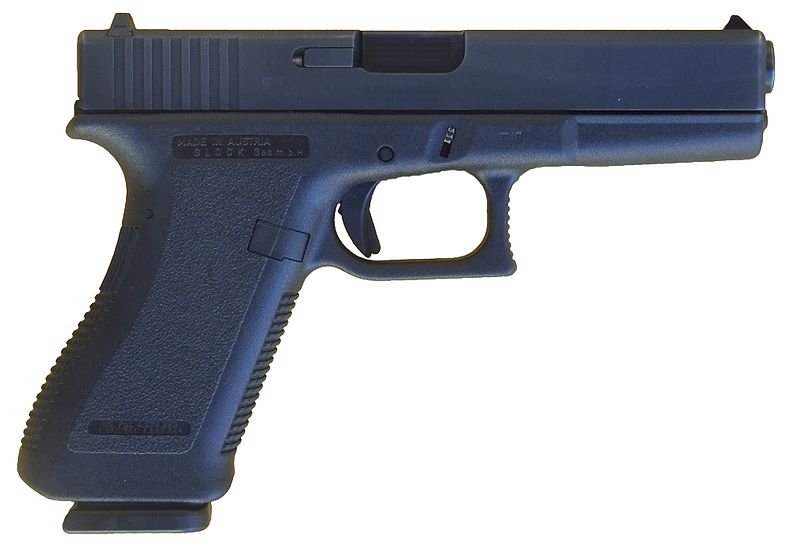
Gen 2 Glock.  Blech.


  • Looks: Fugly.  Like someone took a block of plastic, implanted a trigger, and dropped a block of metal on top.  IMO, the design has gotten sleeker/better since Gen 3 but it's still high function/low fashion.  
  • History/Track Record: One of the most popular service pistols for militaries and police departments worldwide.  That's all that needs to be said.
  • Safe-Action Trigger.
  • Simplicity: This is both a pro and con for me.  Glocks don't screw around.  There are no safety switches/buttons.  The trigger has a little nub that pokes out of the trigger.  To fire the gun the nub has to be pulled back flush with the trigger.  That means that any time you pull the trigger, the gun fires.  You have to be on your game with a Glock.  There's no safeguard to protect your life if you screw up.  This shouldn't be a problem because you should always be cognizant of the 4 rules when handling a gun but it's still intimidating to me.  On the other hand, if my life is threatened and I need to actually use the pistol, there are no buttons/switches to hang me up and possibly cost me my life.  The simplicity is a wash to me.
  • Customizability: The amount of aftermarket parts available for the Glock is second only to the 1911.  You can build one from the ground up with just aftermarkets.  Sights, customer trigger jobs, grip covers, barrels, lights, lasers, you name it.  You can even buy kits to turn your Glock into a Carbine in 6 seconds.  Speaking of carbines, because the Glock 17 is so popular, you can get many carbines that accept the Glock mags.  Also, there are uppers in 9mm that take the same magazines (basically the top of a rifle, just take off the rifle caliber one and put in the one that accepts the Glock mags.)
So we got a mini-con in looks, mini-pros in customizability and track record and simplicity is a wash for me. Misc. ends up being a small PRO.

So when we add it up we have 4 PROs to 2 CONs.  And the two cons are in categories that aren't of a big concern to me personally.  I gotta admit, I started this process not giving two thoughts to the Glock system but it has alot to recommend it.  There's something about buying a pistol that you know is probably going to last a lifetime.  I mentioned the fact that Glock produces basically the same gun in different calibers earlier, that really appeals to me.  It's cool to know that if I were to outgrow the 9mm cartridge and want a .40s&w, .45ACP, or something really bizarre/awesome like a 10mm (.40s&w's pissed off big brother) that the system would be exactly the same.  Also, that double-stack magazine is awesome.  

I can definitely say that I "get it" now as far as the Glock goes.  I'd even say that the research I've done on it has put it in front of the 1911 in my eyes.  I mean, comparing a Glock 21 to a 1911:  Both shoot .45ACP.  One's magazine holds 8, the other 's holds 13.  If both guns are reliable, both more accurate than I'm going to be, etc, that capacity difference is enough to choose a Glock, right?  Theoretically anyway.  We'll have to see how everything holds up to the next couple guns under the QHH microscope.

Feel free to leave your thoughts on the Glock and how you see it.  I realize that most of my readership is used to fishing content here and may not be into guns or familiar with them. If that's you and you have questions or need me to explain anything, just let me know.  I definitely don't have all the answers but I have plenty of opinion and am happy to track down some facts for you.